Florida man injured climbing California’s Mount Shasta rescued after 2 nights in freezing temps

By Tim Fang
A Florida man who became injured while climbing one of the tallest mountains in California was rescued after spending two nights in freezing temperatures, officials said.
According to the sheriff’s office in Siskiyou County and the U.S. Forest Service, the 39-year-old climber summited Mount Shasta around 3 p.m. Sunday. Located in the far northern part of the state at an elevation of 14,179 feet, Mount Shasta is the fifth tallest peak in California and the second tallest peak in the Cascade Range.
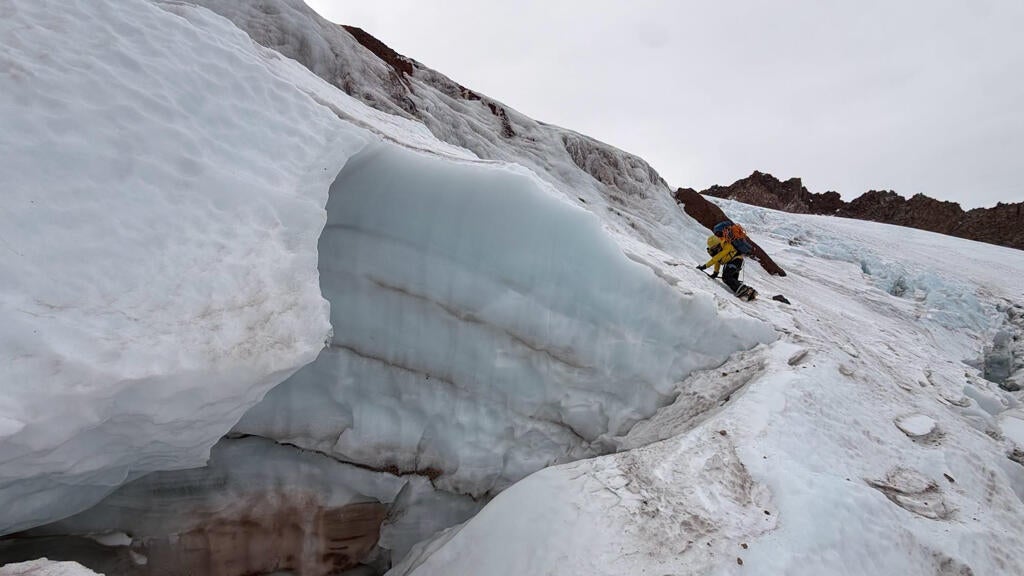
While descending, deputies said the climber ran into trouble after following an erroneous GPS route that led him onto the Whitney Glacier. At 12,600 feet elevation, the climber fell through a snow bridge, severely injuring his leg.
Around 5 p.m., the climber called 911 and the sheriff’s office launched a search and rescue operation.
“At the time of his distress call Sunday evening, the injured climber was wearing only sweatpants, a sweatshirt, and running shoes, and was not equipped for an overnight stay on the glacier,” the sheriff’s office said in a statement.
U.S. Forest Service officials said the man had a pair of trekking poles and a small amount of food and water.
Temperatures on the glacier, known as the coldest part of the mountain, dipped below freezing. High winds and poor visibility also prevented rescuers from reaching the injured man until late Monday morning.
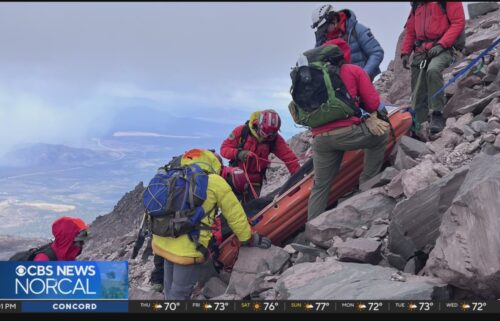
When a pair of climbing rangers from the Forest Service arrived, the man was treated for his injuries, frostbite and the onset of hypothermia. The rangers moved the man off the glacier and made multiple attempts to airlift the man off the mountain, but rescue efforts were impeded by inclement weather.
“The USFS Climbing Rangers had to then spend another harrowing night at 12,500 ft with the injured man, as the Siskiyou County Sheriff’s Office mobilized over 30 additional search and rescue personnel to perform a ground extraction,” deputies said.
Additional crews reached the man around 1:30 p.m. Tuesday, who carried him further down the mountain for a helicopter rescue. Deputies said crews had to encounter multiple challenges, including rockfall hazards, 50 to 60 mph winds and freezing conditions, while the man’s condition was “deteriorating rapidly.”
During a break in the weather, a California Highway Patrol helicopter reached the rescue team on Shastina Peak and airlifted him to safety. The climber was taken to the hospital, where he is being treated for his injuries, including frostbite to his foot and leg, officials said.
Officials did not release the man’s name or where in Florida he is from.
Multiple agencies joined the rescue effort, including search and rescue volunteers from as far as the San Francisco Bay Area and Oregon. The last of the rescuers returned to the trailhead late Tuesday night.
“These rescuers demonstrated impressive resolve throughout the entire ordeal, persevering in extreme conditions, and executing the mission with a relentless commitment to the saving of a life,” deputies said.
Among those agencies was the Marin County Sheriff’s Office Search and Rescue team, which noted that this rescue “may have been one of the most challenging missions” it has ever been assigned to.
“Our team of 11 made the treacherous, near-vertical climb up Mount Shasta, hauling rescue gear to reach a climber who had fallen into a crevasse and broken his leg,” the sheriff’s office wrote on its Instagram page. “Stranded more than 12,000 feet up the mountain, the climber couldn’t be reached by helicopter on day one because severe weather made a safe landing impossible.”
The sheriff’s office said the team used specialized skills and a technical rope system to lower the individual down steep, rocky terrain before getting him to the helicopter.
Several members of the SAR team are youths, including 17-year-old Charlie Pledger and Cody Davis.
“We were both at school when it came in, but it happens a lot,” Davis said. “Stuff happens while we are at school.”
They have a bag packed and ready to go in their cars just in case of emergencies like this one. According to Chief John Van Hooser, the team got there just in time.
“When we got there, it was very clear that he was not going to, he was not likely to be able to survive another night on the mountain,” Chief John Van Hooser said. “So, we needed to get him lower or get him in a helicopter to save his life.”
In the end, it was a successful mission. All the members of the search and rescue team spend hundreds of hours training for these kinds of missions. Pledger and Davis are now back at school, and their parents are relieved to have them back home.
“On this particular one, it was definitely out of the ordinary,” Pledger said. “I was texting her a lot because it was fun to keep her in the loop. She really enjoys hearing about all my experiences, but definitely does worry.”