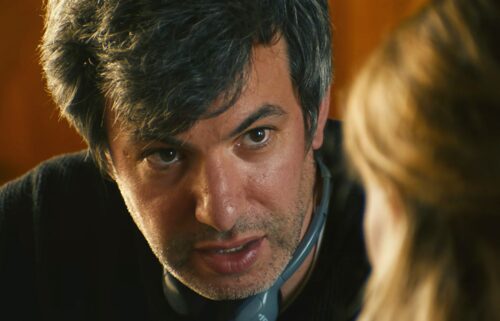
Who is Nathan Fielder, really?

By Zoe Sottile, CNN
(CNN) — Nathan Fielder has been quietly building his cultish brand of meta-comedy since 2013 and has now exploded into mega-stardom thanks to “You Can See Everything,” the three-hour documentary about now-imprisoned Theranos founder Elizabeth Holmes. For those unfamiliar with Fielder’s career or filmmaking approach, his assent to award season hopeful — even frontrunner — has felt like welcoming a strange alien to a planet inhabited by the slick Hollywood establishment.
If you’re new to Fielder, the film might leave you wondering who is this odd man that Holmes, a convicted fraudster, invited to live in her seaside bungalow with her partner and children in the days before she reported to prison? Is he a serious documentarian? A funny trickster? Both?
Fielder’s work, both predating his buzzy feature-length project and the film itself, defies simple description. At its core, his work looks to address a central question: Can you ever really know another person? In his shows and his movies, he combines deep inquiry with awkward comedy, often with himself as a main character. This is his magic trick: Using artifice and absurd scenarios to capture uncanny glimpses of truth, with himself as a prop.
Originally from Toronto, Fielder developed his first inklings of niche fame as the host of Comedy Central’s “Nathan For You,” a docu-reality series that parodied business consultants and their tactics. The show, which launched in 2013 and ran for four seasons, stars Fielder, using his (real) business degree to help (also real) struggling small businesses. Fielder played up a version of himself on the show, acting as a dumbly ambitious business school graduate, socially inept and desperately seeking connection. His schemes were not so helpful. In one episode, he suggested a frozen yogurt shop debut a “poo” flavor, saying the notoriety would draw customers. In another, he placed an ad for a pet store at a pet cemetery.
The show was critically acclaimed, with the New York Times calling it “the television series with the most incisive take on the 21st-century economy.” Documentary master Errol Morris called the season finale, which veered from the business scam format, his “new favorite love story,” an exploration of our collective “unfettered capacity for credulity—not just the suspension of disbelief but the acceptance of the preposterous.”
Fielder followed up “Nathan For You” with “The Rehearsal,” an HBO show that premiered in 2022 and leveraged his obsessive anxious mind and penchant for ultra-realistic simulations. Like “Nathan For You,” “The Rehearsal” used real people — but instead of small business owners, they were people with a problem to solve and, for different reasons, issues communicating.
Fielder constructed elaborate scenarios to allow them to “rehearse” for real-life events, practicing each possible outcome so they could be prepared. When one man wanted to prep for an awkward conversation with a friend, Fielder constructed an exact replica of the bar where the feared conversation would take place. Fielder, still dry but less overtly comic than in “Nathan For You,” played a laptop-toting social architect, a Machiavellian evil genius whose social anxiety became the engine for esoteric social experiments.
Both shows are at once very silly and surprisingly serious. Saying “Nathan For You” is about a business scam or “The Rehearsal” is about problem-solving is like saying “The Titanic” is about a boat. Both shows veer into surprisingly philosophical and meta explorations of love, memory, perception, and performance. Most broadly, Fielder’s exploits depict the near-universal struggle for people to understand each other.
His persona’s failure to understand social norms shows how arbitrary they are. Fielder often plays the loner, the outsider; his struggle to find romantic love is a common theme in his early work. “You remind me of the wizard of loneliness,” one subject tells him on “Nathan For You” in a surprisingly pointed riposte.
Fielder insists his comedic style developed just from being himself. “I noticed that people would laugh at things when the camera was on me that I didn’t intend to be a joke,” he once told British documentarian Louis Theroux.
“At first, it’s humiliating to have people laugh at you when you’re not trying to be funny, but then you’re kind of like, ‘Oh, I guess these aspects of me are funny,’” he said. “Obviously, I can write jokes, but the moments I was always trying to chase were those that were inexplicably funny because they were human.”
The fool and the journalist
In his previous work, Fielder honed the surreal approaches he deploys in “You Can See Everything,” which he co-directed with Lance Oppenheim.
In the new film, as in his previous work, Fielder uses actors to play out real scenarios, and leans on his own dry, bluntly awkward persona to bring out his subjects’ quirks and oddities.
But there are differences, too. In his shows, Fielder tends to let things unfold as they may — he’s not looking to fact check or mock his subjects. “I don’t want anyone to look bad,” he told Theroux. “I want to be the fool.”
In “You Can See Everything,” however, Fielder steps into the role of quasi-journalist, pushing back on Holmes’ relentless insistence of her innocence and naivete. He still makes jokes, but he mostly lurks in the background of Holmes and Evans’ already surreal post-Theranos-implosion life.
Oppenheim says Fielder-opposite-Holmes is the comedian at his most authentic. “I feel like this is the closest we’ve ever come to actually seeing Nathan not being a character onscreen or doing a bit,” he told New York Magazine.
Which doesn’t mean you should take him entirely at face value. “As soon as there’s a camera, it is a performance,” said Sophy Romvari, a filmmaker whose debut feature, “Blue Heron”, blends elements of fiction and nonfiction. “It’s a performance, maybe more of self.”
That’s true of Holmes, Romvari said, and also of Fielder.
“It’s probably a version of himself, but there’s no such thing as, like, capturing the authenticity of a person without some element of performance,” she said. “Because you’re aware that you’re being captured, you’re aware that cameras are there, and you’re aware that there’s something to be either gained or lost in doing that.”
Which might explain why some have scoffed the film’s designation as a documentary. When a film is presented as a documentary, there’s an expectation “that you’re just watching a real person and that this is their true self,” said Romvari. But, she said, “A documentary is just a form of filmmaking like any other.”
The question, Romvari says, isn’t what’s real, for Fielder or Holmes. The project of filmmaking instead – whether it’s fiction or documentary – is to try to capture what’s true: emotionally true for the people we watch.
“I don’t really care so much about, ‘is it real?’” said Romvari.
“It’s not real. But it’s still coming from a place of truth. It’s that person’s truth in that moment.”
The-CNN-Wire
™ & © 2026 Cable News Network, Inc., a Warner Bros. Discovery Company. All rights reserved.