No snow, no problem? Inside Utah’s high-stakes plan for the 2034 Olympics.

Trent Nelson // The Salt Lake Tribune
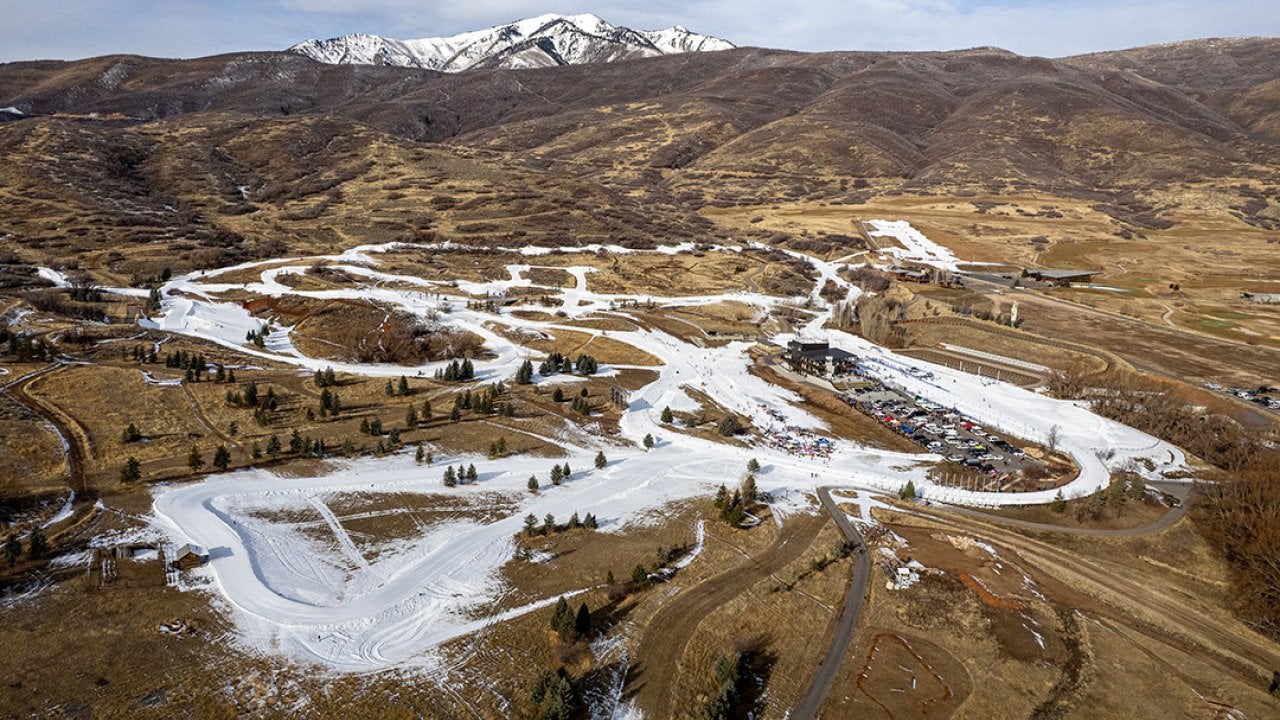
A tangled, white ribbon wrapped around brown hills and barren shrubs at Soldier Hollow Nordic Center on Tuesday, Jan. 27. It was a little more than a week before the start of the 2026 Olympic and Paralympic Games in Milan-Cortina, Italy. It was also exactly two weeks and eight years before Utah takes the stage to host its second Winter Games.
Yet the prospect of hosting elite-level snowsport competitions here is difficult to fathom given the incessant lack of snow and persistent warm temperatures.
That’s especially true at Soldier Hollow. At an elevation of 6,000 feet, it’s the lowest base among Utah’s 2034 venues, and most at the mercy of climate change. Local organizers acknowledge the fact, and a recent study said the venue — which is slated to host biathlon and cross country races — could be too warm to reliably host both Games in the near future.
“We’ve gotten less than three inches of snow this winter, so that’s been interesting,” said Luke Bodensteiner, general manager at Soldier Hollow, which over the past three decades has averaged about 20 inches in January alone. “We’ve actually gotten more rain than snow this year,” he told The Salt Lake Tribune.
No, the snow isn’t falling at Soldier Hollow. But neither is the sky.
This warm, dry, brown winter is driving home the ripple effects a warming planet can have on the ski industry and the Olympics, said Fraser Bullock, the Utah 2034 president. Still, he said, he’s confident the state can weather similar conditions if they arise in 2034 and beyond. All it needs is state-of-the-art snowmaking, a flexible calendar and, maybe, a sprinkle of salt.
Is snowmaking the answer?
Like a slip peeking out under a skirt of snow, the brown and craggy rocks of the mountainside show on either side of the ski run. The scene could be at almost any of Utah’s ski resorts this winter. Instead, it was mid-January at Cortina d’Ampezzo, Italy, the site of the women’s downhill ski competitions for the 2026 Olympics, which began Friday, Feb. 6.
Like Utah, Italy has experienced an unusually dry and warm winter. It has been so dry that Johan Eliasch, president of the International Ski Federation, voiced concern in early January that the ski courses wouldn’t have enough snow in time for the Olympics. He also blamed Italian officials for the shortage.
Then Italy turned up its snowguns to full tilt.
“We have been very lucky with the cold weather,” Eliasch said last week, according to a report by Barron’s. “Snow production has been able to commence and hit all the targets.”
Artificial snow — or, as the International Olympic Committee refers to it, “technical snow” — has become a life raft for the Olympics. Sochi, Russia, could only host its 2014 Games thanks to snowmaking. The resort city along the Black Sea, which had some of the warmest temperatures ever for a Winter Games — hovering around 60 degrees Fahrenheit — manufactured 80% of its snow. When Pyeongchang, South Korea, hosted its Winter Olympics four years later, it needed to make 90% of its snow. By the time Beijing hosted in 2022, it was believed to have completely relied on artificial snow.
The snowmaking process has been criticized for its intensive water and energy use. Nonetheless, it has become so omnipresent at ski and snowboarding competitions that many elite athletes now prefer manufactured snow, with its more predictable consistency, to the real stuff.
Recent advancements that make snowmaking more efficient leave Bullock with no doubts Utah can host the 2034 Winter Games. What’s more, he believes the state can do it while meeting the IOC’s recent edict that, starting in 2030, every edition of the Games be climate positive.
“This year, in particular, has been very disappointing in terms of snow coverage and snow received,” Bullock said. “[Yet] when we take a step back and look at: ‘How effectively can we still host the Games?’ We have tremendous confidence.”
Utah 2034 organizers plan to replace existing snowmaking equipment — much of which was installed for the 2002 Olympics — at most venues. The new systems can use as little as half as much energy as their predecessors. They also allow mountain managers to take advantage of even 30-minute windows of ideal snowmaking conditions with the touch of a button, which proponents say makes them more water efficient.
The IOC supports snowmaking at Winter Games venues, despite its environmental costs.
“Climate change is already reshaping winter sport as we know it,” an IOC spokesperson wrote in an email to The Salt Lake Tribune. “Our ambition is to protect the Games and winter sports that so many people love; minimise its impact on the environment; and help safeguard winter economies that so many people rely on.”
But what about when temperatures are too warm to make snow?
Generally, snowmaking is only worthwhile if the wet-bulb temperature — a combination of humidity and heat — is 28 degrees Fahrenheit or colder. Making snow at warmer temperatures is possible, but it is neither efficient nor economical.
And as Utah skiers and snowboarders know, much of the 2025-26 season has been too warm for snowmaking, even at night. Only in recent weeks have temperatures dropped enough to allow resorts’ snowguns to fire with any regularity.
But that’s the beauty of late winter in Utah, Bullock said. The state consistently sees cold temperatures in January and February, which lines up perfectly with the 2034 Olympic timeline of Feb. 10-26. Once the chill settles in, Bullock said, mountain managers will likely need less than a month to manufacture all the snow necessary to make an Olympic course competitive and safe.
“The proper concentration of snowmaking equipment focused on our competition runs for a couple of weeks would certainly give us the preparation we need,” he said. “But we believe we’ll have far more (time) than that.”
And if mountain managers don’t have enough time, or enough cold weather to make snow? Then, they’ll go old-school.
Turning to tarps and trucks
Even back in 2002, organizers of the Salt Lake City Olympics fretted over a potential snow shortfall during the Games.
As a backup plan, Bullock said, snow was collected and stored under insulated tarps at Strawberry Reservoir, which sits at an elevation of 7,600 feet. Dump trucks were on call to haul the frozen gold to Soldier Hollow, 40 miles to the north, or to any of the four other outdoor competition venues.
Bullock said that plan could be reinstated for 2034. In a pinch, he said, organizers might even cull from other high-altitude locations in the state. He chuckled, however, at the suggestion that snow might be brought in from other states, such as Colorado or California.
“No, that’s too far,” he said. “We can make it here.”
Bodensteiner, Soldier Hollow’s general manager, said he doesn’t expect even that effort to be necessary, though. Instead, he said the Nordic area — a Utah Olympic Legacy Foundation property that is funded by an endowment from the 2002 Olympics — plans to make enough snow in advance that it can pull from its own reserves. In fact, he said his snowmaking team is experimenting with blowing snow now that can be stored over the summer under insulated tarps. If it holds up, Soldier Hollow will use it to open in early November next season.
“We know it’s viable,” he said. “But in 2034, rather than be prepared to truck snow down from Strawberry, we’re probably just going to make it the year before and store it on site here.”
It would, he noted, likely be the more ecological and economical option.
“Who wants to send 300 dump trucks up to Strawberry?” he asked.
Once the snow is in place, Bodensteiner has some creative solutions for keeping it from melting.
Like a sprinkle of salt.
Soldier Hollow sits near the top of the International Ski Federation’s elevation threshold for Nordic races — basically, the sweet spot between having both snow and oxygen. So, even when temperatures are well above freezing — as they were during a 2024 biathlon World Cup stop — it’s not possible to move races to a colder, higher-altitude venue. As a result, Bodensteiner and his team had to develop a surefire cure for slush.
The salt lowers the temperature at which the snow will melt, the same reason it is added to ice cream.
“We will basically salt the trail by hand or pull an instrument at the end of a snowcat and spread salt on the trail,” he said, “and within five minutes, it turns from slush into really, really hard, kind of icy snow.”
Such strategies could get Utah through 2034, even if that winter is as dry as this one. Yet if organizers want to host even more Winter Games beyond 2034, as they’ve said they do, even those solutions may not be enough.
For when that time comes, local Olympic organizers have one more trick up their short sleeves.
Trent Nelson // The Salt Lake Tribune
A matter of time
Utah wasn’t on the chopping block, until it was.
A 2018 study published in the journal Current Issues in Tourism found that fewer than half of the 19 sites that hosted the Winter Olympics between 1980 and 2010 would be cold enough to host again in 2050. Among those that made the cut was Utah.
Last month, however, those same researchers published another study in the same journal that casts a less rosy glow on the event’s future in the state. This study looked at 93 past and potential hosts, as selected by the IOC, and evaluated whether they would be viable future hosts for the Winter Olympics and Paralympics without the help of snowmaking.
“We wanted to … see how many reliable locations would there be left,” climate impact and tourism researcher Robert Steiger said, “if we would not have man-made snow or anyone would say, ‘No, we don’t want to have snowmaking because of ecological impacts.’”
The study found that by 2030, without snowmaking, just two sites would be able to host both the Olympics and Paralympics as currently scheduled. One is in Russia and the other is in Japan.
If emission levels remain high — or “business as usual,” as Steiger put it — the IOC’s choices will be limited even with snowmaking. The study found just 17 sites would be able to host by 2050 and a mere four by 2080.
Of those four, the one in North America is not Utah. It’s Canada’s Lake Louise.
The timing of the Paralympics is at the crux of the dropoff, according to the study. Typically, those Games are in March, when temperatures naturally begin to rise. Climate change is expected to make them rise higher, earlier.
Most troubling for Utah, the report cast some doubt on whether the state will be able to provide enough snow and cold temperatures to host the Paralympics as soon as 2034.
“While climate reliability is sufficient for the [Paralympics] in the French and Italian Alps in the 2030s,” the report said, “the risk of marginal conditions is higher for Salt Lake City.”
Bullock said local organizers are well aware of the problem. He doesn’t believe the 2034 Paralympics, scheduled for March 10-19, will be in danger. Beyond that, though? In the absence of any major breakthroughs in snow alternatives or snowmaking, he said organizers have just one clear option.
“The best solution,” he said, “is to look at the calendar.”
It is likely that the dates of future Utah Olympics or Paralympics or both will have to be changed, Bullock said, in order to avoid bleeding into March.
One option is to shorten the gap between the Olympics and the Paralympics. Typically, between two and three weeks separate the Games. Another option is to move up the start of the Olympics into the first week of February or even the last week of January. That would allow the Paralympics to fit entirely into the colder month of February while still allowing enough time to transition venues to the smaller Paralympic footprint.
Organizers considered holding the Paralympics before the Olympics, but scrapped that idea because of logistical challenges.
“I think it’s just easier,” Bullock said, “to move everything forward to accommodate the Olympic Games.”
Changing the calendar comes with its own set of complications, though.
For example, if the Olympic and Paralympic Games are held earlier in the year, the window in which athletes can qualify for their events will be abbreviated. In a winter like this one — which saw several early events canceled or moved for lack of snow, including the Freestyle Skiing World Cup at Deer Valley Resort — it could affect who does and doesn’t qualify.
The sky wouldn’t fall, but Olympic dreams might.
“If they move [the dates] up, too, and we have a year like this, it’s going to be really hard for them to get the snow in time,” said Charlie Mickel, a Park City resident whose performance two weeks ago at Waterville Valley Resort, which stood in for the Deer Valley World Cup, helped him clinch a spot on the Team USA moguls squad for the 2026 Olympics.
“If they had a repeat year like this in 2034, like, I don’t know how. It would seriously be a disaster.”
This story was produced by The Salt Lake Tribune and reviewed and distributed by Stacker.


